

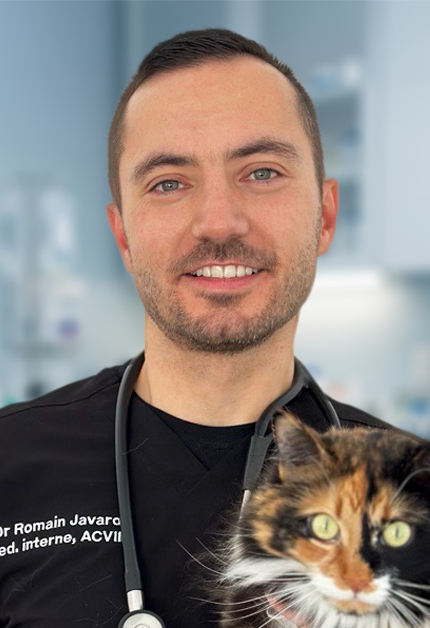
Veterinary Specialty
Interventional medicine
Veterinary Specialty
Interventional medicine
Advanced Care Through Minimally Invasive Procedures
Interventional medicine is revolutionizing the management of many medical conditions by offering minimally invasive solutions for diagnosing and treating complex pathologies. Unlike traditional surgery, these interventions reduce pain, complications and recovery time for animals.
Our advanced techniques enable us to intervene effectively on the cardiovascular, digestive and urinary systems, offering modern treatment options tailored to each patient.
Interventional Ultrasound
Direct access to internal organs for targeted biopsies and drainage procedures.
Real-Time Fluoroscopy
Dynamic imaging for precisely guided procedures.
CT Imaging & Advanced Diagnostics
Accurate diagnostic imaging to guide precise, minimally invasive treatments.
Specialized Maxillofacial Surgery
Treatment of tumors, fractures, and congenital abnormalities.
Advanced Anesthesia Techniques
Optimal pain management for improved postoperative comfort.
Interdisciplinary collaboration and personalized care
Our interventional medicine team works closely with the departments of cardiology, oncology, neurology and internal medicine to offer comprehensive, personalized care. This multidisciplinary approach optimizes results by tailoring each procedure to the animal’s specific needs.
Whether you’re looking for a targeted intervention or an alternative to traditional surgery, our interventional medicine department is on hand to offer innovative solutions that always respect animal welfare.
FAQ
Frequently Asked Questions
What is veterinary interventional medicine?
Interventional medicine is a minimally invasive approach used to diagnose and treat a wide range of conditions without the need for major surgery. It relies on advanced technologies such as:
- Fluoroscopy (real-time imaging)
- Interventional Ultrasound
- Endoscopy and Catheter-Based Procedures
- CT-Guided Procedures for Precise Interventions
What types of conditions can be treated with interventional medicine?
Our board-certified specialists provide advanced care for:
- Cardiovascular conditions (closure of congenital shunts, tracheal and vascular stent placement)
- Urinary tract disorders (ureteral obstructions, cystoscopy, and lithotripsy for urinary stones)
- Inoperable tumors (chemoembolization and image-guided biopsies)
- Gastrointestinal disorders (foreign body removal and placement of gastroenteric feeding tubes)
What are the advantages of interventional medicine over conventional surgery?
- Minimally Invasive: No major incisions, resulting in less pain and stress for your pet.
- Faster Recovery: Shorter hospital stays and quicker recovery times.
- Lower Risk: Reduced risk of post-operative complications.
- Precision-Guided Procedures: Advanced imaging technology enables highly accurate, targeted interventions.
What are the risks associated with interventional procedures?
The risks are significantly lower than with traditional surgery but may include:
- Localized inflammation following the procedure.
- Infection, managed through close monitoring and appropriate post-procedure care.
- Risk of recurrence, depending on the condition being treated.


